 I expect this might be a tedious exercise, looking into BRAINnet and Brain Resource , but it seems to have captured the fancy of some fairly important people that represent some fairly important institutions – so for me, it’s worth taking a few minutes to see what it’s all about. Brain Resource is an Australian Company headquartered in Sydney lead by Dr. Evian Gordon. Here’s his letter to the stockholders in 2010 [click on it for a fully readable copy]: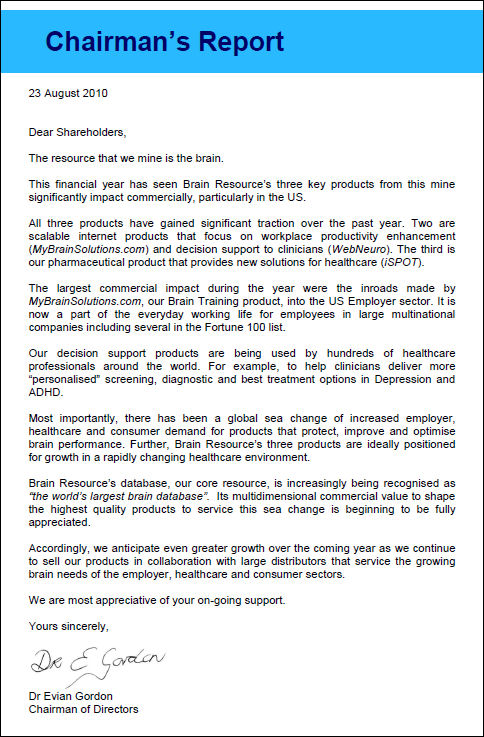
 This first product is available to individuals or as the letter says to employers for their employees. Essentially it involves taking an on-line test to determine your brain profile. Based on that assessment, you receive a prescription of brain training exercises that involves on-line games and interactive videos. There’s a personal dashboard that tracks your progress as you repetatively go through these brain training exercises. Their description of the science of this system is explained on the site.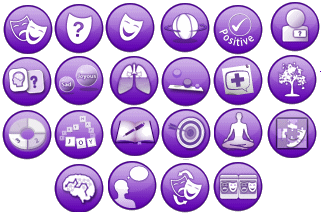
- Negativity Bias – vulnerability risk for brain health problem
- Emotional Resilience – capacity for coping
- Social Skills – engagement, capacity to seek support
- Depression – severity of depressed mood
- Anxiety – severity of anxiety and worry
- Stress – severity of signs of stress that have a physiological basis
 Their second product is billed as solutions for clinical management and seems to be aimed at the Primary Care market to screen for emotional health [and more]. The format seems to be similar, at least at the start – a web administered psychometric test or series of tests generating an immediate report. It’s actually two different products BRISC and WebNeuro that differ in aim and complexity.
| What is BRISC? |
| A screening tool that identifies risk for a brain health issue. BRISC identifies core domains of brain health relating to both Self-regulation and Feelings. It consists of 45 questions and takes 5-10 minutes to complete. BRISC gives you numbers from 1 [clinically significant] to 10 [superior] for: Self-Regulation Feelings |
| BRISC is available for Adults and Children aged 6 – 18 |
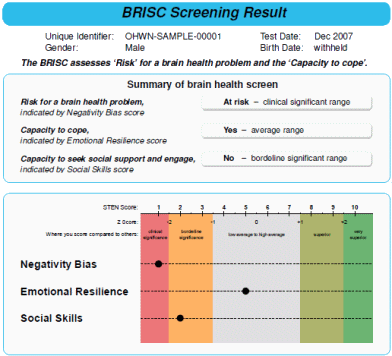
a sample BISC Report
Note from the ghost in the machine: Were I reading this, I’d be thinking something like, "I know you call yourself 1boringoldman, but don’t you think you’re pushing your luck? Why are you reviewing a company that sells self-help brain training programs and mental health screening for GP’s offices?" Fear not, we’re about to be picking up steam. By the end of the next post, we’re going to be doing MRIs, traversing the genome, locating biomarkers, recommending and discovering new drugs, and revolutionizing the world of personalized medicine.
- Case identification – including vulnerability risk for mental illness
- Management plan – supporting decisions treatment initiation or specialist referral
- Reviews – a time schedule for follow up assessment
| What is WebNeuro? |
| WebNeuro is an objective, quantitative and standardized assessment of both symptoms and neurocognition to support more informed clinical decisions. Additional information is also provided on important vulnerability factors such as negativity bias and emotional resilience: The report helps in determining: |
| WebNeuro is available for:
Adults [WebNeuro Wellness]
Children aged 6 – 18 [WebNeuro Focus]
|
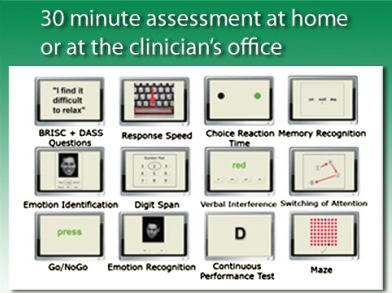
WebNeuro involves multiple tests
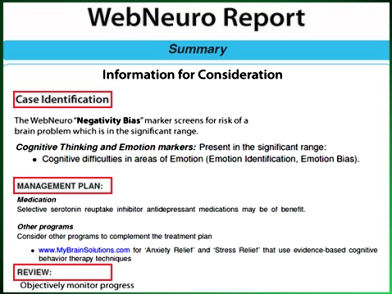
a sample of the summary of a WebNeuro Report
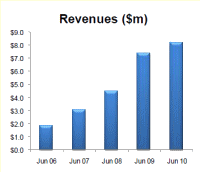 Another note from the ghost in the machine: That’s enough for this time. So far, Brain Resources is a small company doing web-based brain training and neuro-psychiatric assessments using proprietary instruments. Their markets are individuals, corporate clients, and general physicians offices for mental health and some mental illness screening. Their financial growth has been moderate, but steady since they started. In the next installments, we’ll look at their more expansive plans for the future and connect Brain Resource, BRAINnet, and Personalized Medicine.
This is probably not a fair observation, but I’ve always been somewhat skeptical of doctors who feel the need to include “Dr” in their signatures. Is that an Australian thing?
Isn’t that the same as adding “MD” after your name, Steve?
I’m talking about the signature, Stephany.