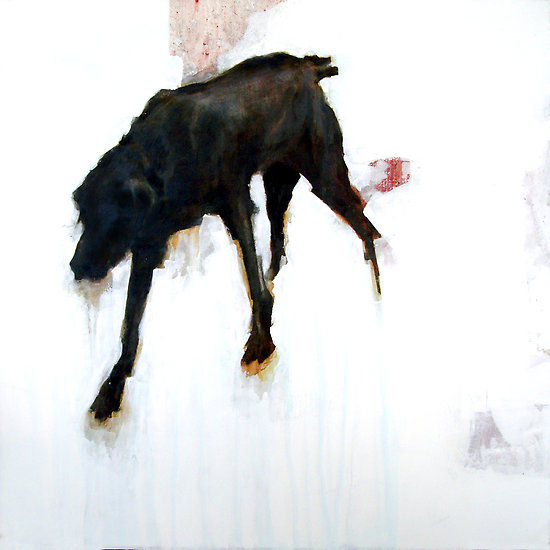
 Sir Winston Churchill called his depression ‘the black dog’ – a term that apparently reaches back into antiquity and resonates with the experience of the afflicted. It’s a noun, an entity, something that’s always there, sometimes biting, but at other times just lurking on the side as in Albrect Dürer’s woodcut
 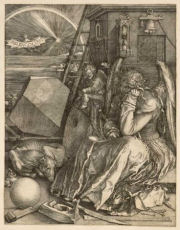 Melancholia. And when you walk in the room with a person who is living with the ‘black dog’, you can usually feel its aura as well. I’ve always been impressed that people with this kind of depression can really think of nothing else with any energy. If they are communicating at all, the central theme of the communication is about this unseen presence that dominates their experience. No singing…
 Then there’s something called the Blues:
Trouble in mind,
Lord I’m blue!
But I won’t be blue always.
‘Cause the sun’s gonna shine
In my back door some day…
 The Blues are something you’ve got, a part of you, often for some reason or because of some circumstance. They may be profound
No, I’m not going to try to turn these examples into a new nosology for depression. I’m just trying to make the point that depressions are not on a monotonous continuum separable only by severity or duration as suggested by the DSM III. The variance among the DSM III diagnostic criteria for a major depressive episode, a dysthymic disorder, and an atypical depression essentially reduce down to those two factors. That doesn’t feel any more correct today than it felt in 1980 when the DSM-III was fresh out of the package. Clinically, there are qualitative differences, and adjustment disorder with depressed mood doesn’t resolve the problem.
When I wrote Dr. Carroll about the state of things pre-DSMIII, he sent along the slide and his letter to Dr. Spitzer that I posted earlier [see Depression: DSM III 2…]. He also included a chapter called The Classification and Treatment of Depressive Disorders by Joseph Shildkraut and Donald Klein in Shader’s Manual of Psychiatric Therapeutics: Practical Psychopharmacology & Psychiatry. Little Brown & Company. pp 39-61. (1975).
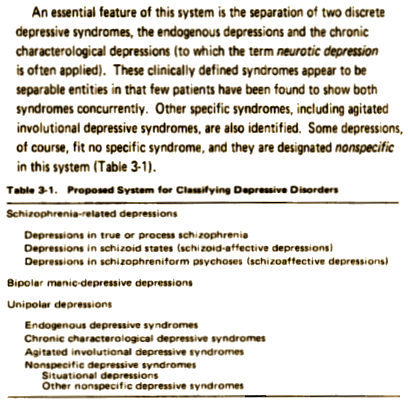
Reading this was like getting reacquainted with an old friend. It’s what I remember as the standard of the time and would’ve expected to be in the DSM III in those days. I think it’s what these authors expected too [footnote]:

I love this blog because it brings together the twin genius (if I may use that term) of a psycho-analytically-oriented psychiatrist (Mickey) and a a biological psychiatrist (Carroll). And the future of psychiatry resides in the synthesis of your collective, creative craniums. Please keep it up!
Have you ever thought about writing an e-book or guest authoring on other websites? I have a blog based on the same ideas you discuss and would love to have you share some stories/information. I know my viewers would value your work. If you’re even remotely interested, feel free to send me an email.